
St. Bartholomew Roman Catholic Church
Features
| Address | 4 Kerkplein |
|---|---|
| Zip Code/City | 4765 CJ Zevenbergschen Hoek |
| Known by cadastral number | – |
| Current Position | Church |
| Original function | Church |
| Year of Manufacture | 1948–49 |
| MIP code | BK130-000922 |
Explanatory description
History
In 1886, the three-aisled cruciform basilica designed by C. Weber was consecrated. However, it was destroyed during the war in 1944. After the war (1948–49), the church was replaced by a new church designed by F.H.M. Mol and W.J. Bunnik. J. Dijker added two stained-glass windows to the church.
Location
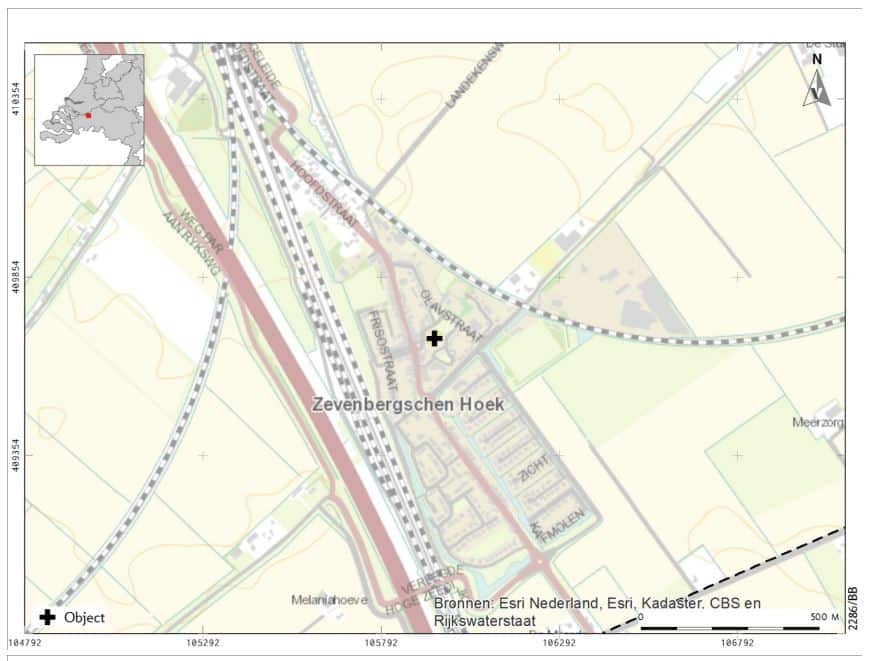
Located on the church square.
Architectural and art-historical features:
Exterior
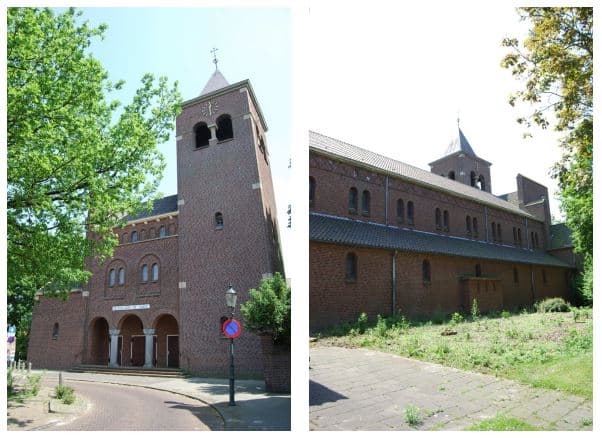
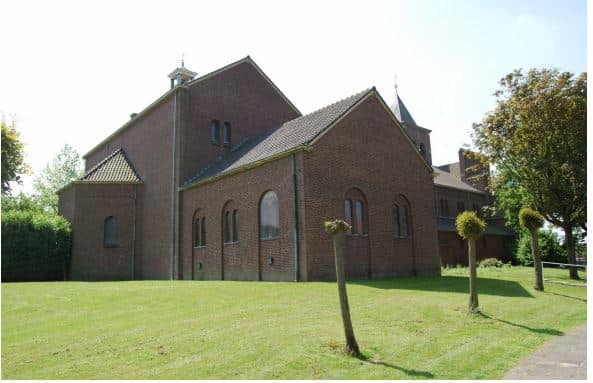
The church (1948–49) was built in the style of the Bossche School. It is a three-aisled basilica with a higher transept, lower transept arms, and a three-sided apse.
The church is constructed of brick and features gable and hip roofs (composite roof) with improved Dutch roof tiles. At the intersection of the roof, there is a square ridge turret topped with a cross. The entire building has round-arched windows, some of which are paired.
The front facade features a three-part portico with columns, surmounted by two paired round-arched windows and a round-arched frieze beneath the cornice. On the right side is a tower with a hipped roof, and on the left side is an extension with a gable roof. The side facade and apse feature a brick bas-relief with a triangular motif beneath the cornice.
Public Interest
The building is of public interest. It has cultural and historical value as a church. It is a landmark and has a striking silhouette. It has architectural and historical value as a church in the style of the School of 's-Hertogenbosch.
Protection
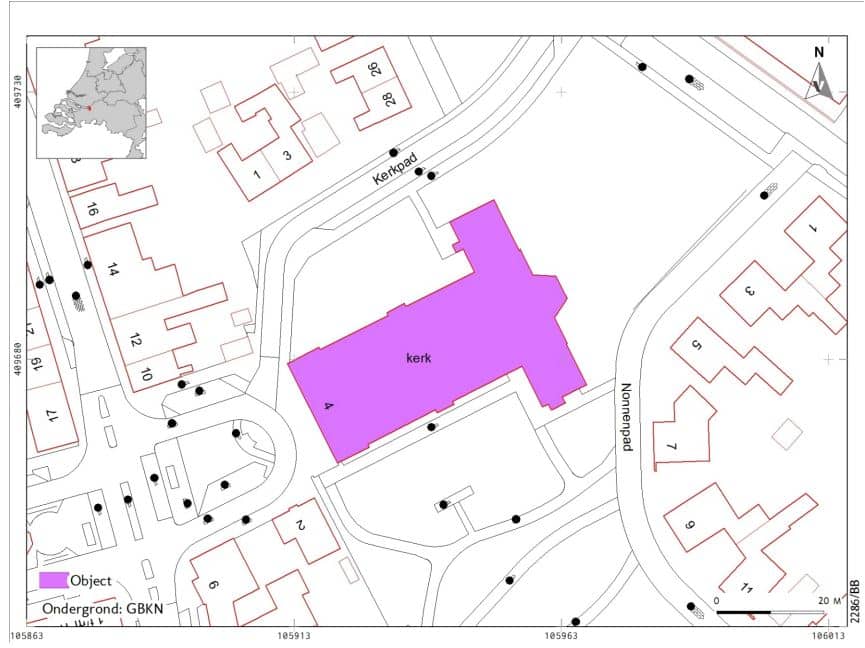
The protection applies to the property at Kerkplein 4 in Zevenbergschen Hoek. The main aspects of the elements worthy of preservation as historic monuments—which are related to the historic values of the entire property—are included in the explanatory description. For the property at Kerkplein 4 in Zevenbergschen Hoek, this concerns relevant parts of the exterior and (parts of) elevations visible from public spaces; in this case, for the main building, the front elevation (southwest side), both side elevations (northwest and southeast sides), the rear elevation (northeast side), and the elements mentioned in the explanatory description.
Future changes or modifications will be evaluated against these criteria—specifically, the visible parts, in this case both the southwest side (excluding the modern concrete elements) and the northeast side of the lock, as well as the elements mentioned in the explanatory description. Future changes or modifications will be assessed against these criteria. (northeast side) and the right-
side view (northwest side) and the elements mentioned in the explanatory description. Future changes or modifications will be assessed against these criteria.
| Evaluation Criteria | Subcriteria | Parameter Descriptions | Score | Weighting | Points | Explanation |
|---|---|---|---|---|---|---|
| Silhouette effect | Silhouette Value | The object’s unique, defining significance to the character of its surroundings, neighborhood, city/town, or region | 3 | 2.0 | 6.0 | An iconic, striking silhouette. |
| Subtotal | 0–6 | 6.0 | ||||
| Location | Ensemble Value | special significance of the property due to the high quality of the buildings in relation to the historical and spatial context | 1 | 0.5 | 0.5 | The church is located near the main road in Zevenbergschen Hoek. |
| the significance of the object as an essential (cultural-historical, functional, and/or architectural-historical and visual) component of a complex | 0 | 0.5 | 0.0 | Not part of a complex. | ||
| situational value | Distinctive location | 3 | 0.5 | 1.5 | Centrally located on a church square just off the Hoofdweg, but still visible from the Hoofdweg. | |
| special significance of the property due to its layout, design, or amenities | 2 | 0.5 | 1.0 | It is located slightly farther from the main street than the other historic row houses and therefore also deviates slightly from the historic street layout. | ||
| Subtotal | 0–6 | 3.0 | ||||
| Form | representativeness | the property’s special significance to the history of architecture and/or construction technology and/or the body of work of a master builder, architect, engineer, or artist | 3 | 1.0 | 3.0 | The church, built in the style of the Bossche School by W.J. Bunnik and F.H.M. Mol, was constructed during the postwar reconstruction period. |
| aesthetic value | significance of the property due to the design's high aesthetic qualities | 2 | 1.0 | 2.0 | It is a three-nave basilica-style church with a higher transept and a three-sided apse, built in the style of the School of 's-Hertogenbosch. It is constructed of brick and features a composite roof with improved Dutch tiles. | |
| Use of Materials and Ornamentation | significance of the object due to its unique use of materials, ornamentation, and/or monumental art | 2 | 1.0 | 2.0 | Various decorative elements have been incorporated into the building, such as round-arched windows, a round-arched frieze beneath the cornice, a three-part portal, and a bas-relief. | |
| integrity/recognizability | significance of the property due to its material, technical, structural, and/or architectural integrity and/or recognizability | 3 | 1.0 | 3.0 | The church is intact and easily recognizable. | |
| rarity | significance of the building/complex due to its exceptional rarity from an architectural-historical, structural, typological, or functional perspective | 2 | 1.0 | 2.0 | It is fairly rare as a post-war church in Moerdijk. | |
| Subtotal | 0–15 | 12.0 | ||||
| Cultural History | cultural and historical value | the significance of the property as a unique expression of cultural, socioeconomic, administrative/policy-related, spiritual, geographic, landscape, historical-spatial, technical, and/or typological development(s) | 3 | 2.0 | 6.0 | As a special expression of spiritual development. |
| innovativeness | significance of the property due to its innovative value or pioneering nature | 0 | 1.0 | 0.0 | No innovative value. | |
| sentimental value | significance of the property due to its special sentimental value | 2 | 2.0 | 4.0 | A reminder of the church’s role and of World War II, followed by reconstruction. | |
| Subtotal | 0–15 | 10.0 | ||||
| Position | authenticity | the significance of the property as a still clearly recognizable expression of its original or an important historical function | 3 | 2.0 | 6.0 | Still in use as a church. |
| Subtotal | 0–6 | 6.0 | ||||
| Total | 0–48 | 37.0 | ||||