
Sugar Factory
Features
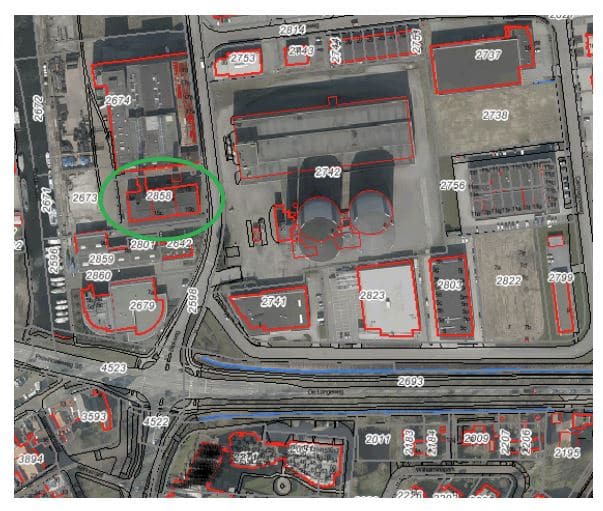
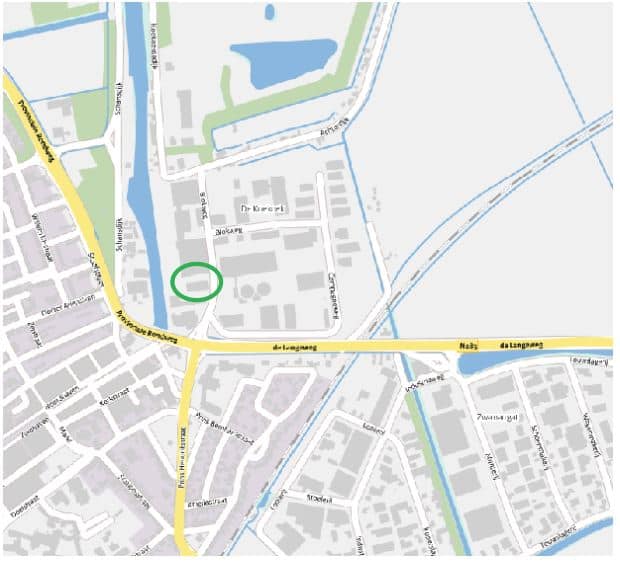
| Address | 15 Blokweg |
|---|---|
| Zip Code/City | 4761 RA Zevenbergen |
| Known by cadastral number | – |
| Current Position | Storage |
| Original function | Sugar Factory |
| Year of Manufacture | 1945 and 1946 (chimneys) and 1951 (former boiler house) |
| MIP code | BK130-000846 |
Explanatory description
History
The first Dutch beet sugar factory was founded in Zevenbergen in 1858. Its origins lie on the Huizersdijk, where the Azelma sugar factory was most likely built in 1858. In 1867, the madder factory, the Phoenix, was converted into a sugar factory. In 1872, the third sugar factory in Zevenbergen, De Dankbaarheid, was built. It was located on the Schansdijk.
Across the water, on the De Roode Vaart, a sugar factory (now on Blokweg) was built in the early 20th century (probably around 1912). As several sugar factories merged into a cooperative, many privately owned factories disappeared because they could not compete with the cooperatives. The factory on Blokweg in Zevenbergen was established following the formation of a cooperative. As a result, the sugar factory on Blokweg had a legitimate reason to exist and expanded significantly in the years that followed. The first buildings at this location were situated at what is now Blokweg 17–19. Between World War II and 1969, the facilities were significantly expanded. During this period, the two chimneys (1946 and 1947) and the former boiler house (1951) were constructed; the boiler house is now located at Blokweg 15.
In 1987, this factory also closed its doors, bringing an end to a long history of the sugar industry in Zevenbergen.
Location
De Roode Vaart, situated in a striking location.
Architectural and art-historical features:
Exterior
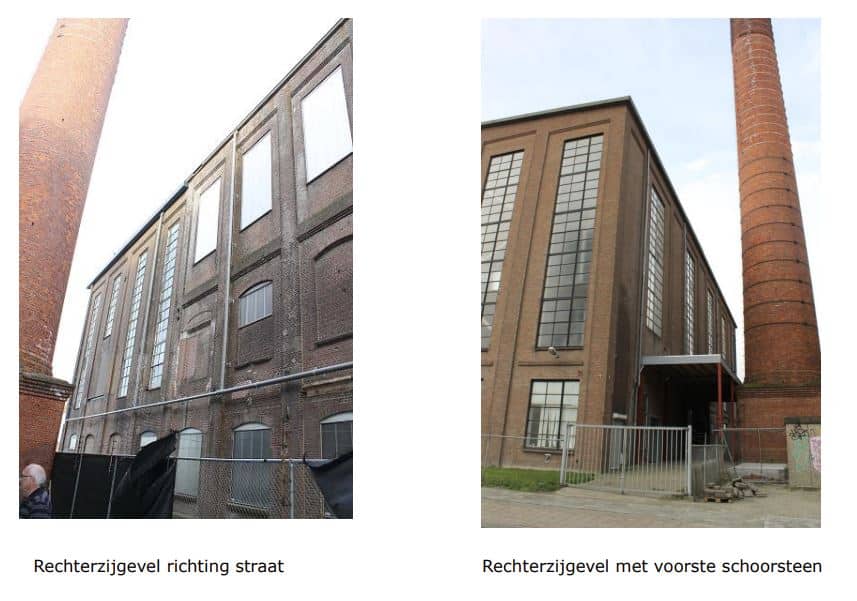
The chimneys are constructed of red machine-cut brick. The round chimney rests on a square base measuring 5.90 x 5.90 meters and approximately 5 meters high. Above that, the round chimney begins, with a diameter of approximately 5.5 meters at the base and 3.5 meters at the top. The total height of the chimney is 50 meters, the first 25 meters of which are constructed of double-walled masonry.
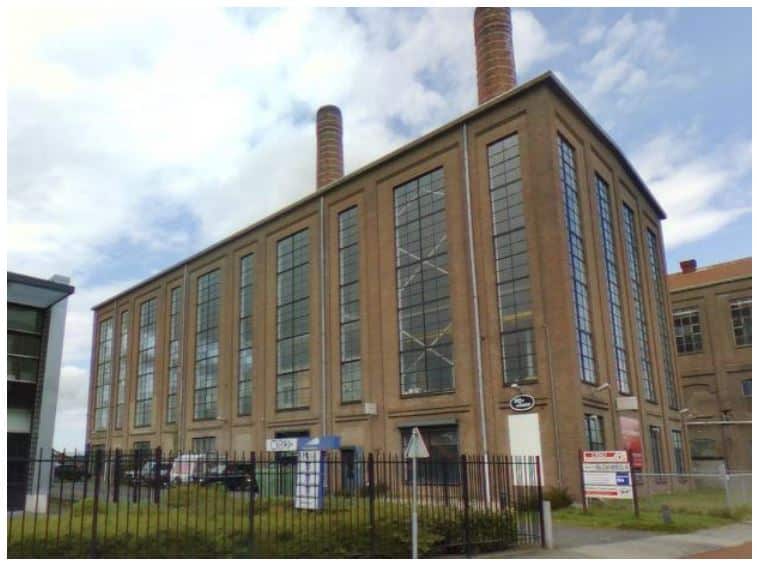
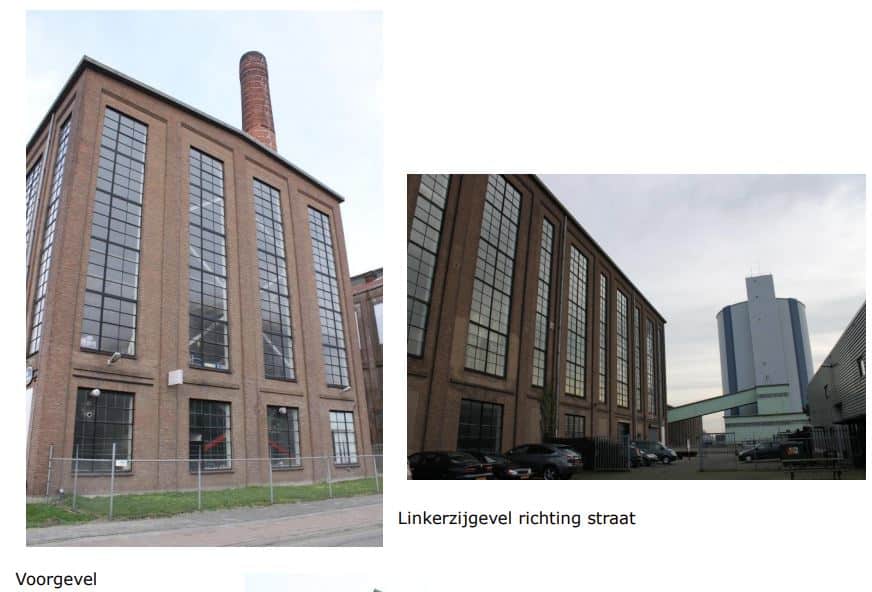
The former boiler house is also constructed of machine-cut brick, predominantly in a half-brick bond. It features pilasters and moldings, also in masonry. The black steel windows have a wide grid pattern that is subdivided by a narrower grid pattern. The window openings in the left side and rear facades are fitted with wire-reinforced glass. The window openings in the front and right side facades retain their original glass. The roof consists of a concrete cassette roof covered with bitumen. From the interior, various roof penetrations—including a skylight—are still clearly visible in the cassette ceiling.
Excluded
Various openings in the facades have been (partially) bricked up or fitted with roller shutters, and various advertisements have been added. There is also a carport on the right side of the property. These elements are not subject to municipal protection.
Public Interest
The property is of public interest. It has cultural and historical value because it represents the long history of the sugar industry in Zevenbergen. The chimneys are a defining feature of the skyline of Zevenbergen-Noord. The sugar factory is located on the Roode Vaart and is visible from the N285 provincial highway.
Condition of Maintenance
The overall condition of the chimneys is fair. The upper sections of the chimneys need to be restored. The boiler house is in good condition.
Protection
The protection applies to two chimneys and the former boiler house at Blokweg 15 in Zevenbergen. The main aspects of the elements worthy of preservation as historic monuments—which are related to the historic values of the entire property—are included in the explanatory description. For the two chimneys and the former boiler house, this concerns relevant parts of the exterior and (parts of) elevations that are visible from public areas; in this case, this includes all elevations and the elements mentioned in the explanatory description.
Future changes or modifications will be evaluated against these criteria. The entire property is included in the explanatory description. For the lock on the Barlaaksedijk in Standdaarbuiten, this applies to the visible parts—in this case, both the southwest side (excluding the modern concrete components) and the northeast side of the lock, as well as the elements mentioned in the explanatory description. Future changes or modifications will be assessed against these criteria. (northeast side) and the right-
side view (northwest side) and the elements mentioned in the explanatory description. Future changes or modifications will be assessed against these criteria.
| Evaluation Criteria | Subcriteria | Parameter Descriptions | Score | Weighting | Points | Explanation |
|---|---|---|---|---|---|---|
| Silhouette effect | Silhouette Value | The object’s unique, defining significance to the character of its surroundings, neighborhood, city/town, or region | 3 | 2.0 | 6.0 | The boiler house—and especially the chimneys—create a distinctive silhouette. |
| Subtotal | 0–6 | 6.0 | ||||
| Location | Ensemble Value | special significance of the property due to the high quality of the buildings in relation to the historical and spatial context | 0 | 0.5 | 0.0 | The buildings are not part of a historic urban structure. |
| the significance of the object as an essential (cultural-historical, functional, and/or architectural-historical and visual) component of a complex | 0 | 0.5 | 0.0 | The boiler house and the chimneys are part of a complex. The other structures are not currently designated as historic landmarks. | ||
| situational value | Distinctive location | 3 | 0.5 | 1.5 | Situated in a striking location along the Roode Vaart River. | |
| special significance of the property due to its layout, design, or amenities | 0 | 0.5 | 0.0 | No particular significance due to the layout of the parcels, the road network, or the waterways. | ||
| Subtotal | 0–6 | 1.5 | ||||
| Form | representativeness | the property’s special significance to the history of architecture and/or construction technology and/or the body of work of a master builder, architect, engineer, or artist | 2 | 1.0 | 2.0 | The chimneys date from 1946 and 1947 and are currently the only remaining twin chimneys in the Netherlands. |
| aesthetic value | significance of the property due to the design's high aesthetic qualities | 2 | 1.0 | 2.0 | The boiler house is constructed of brick and features a concrete cassette roof slab. The facades are symmetrically divided by brick pilasters, between which a steel window with glazing bars has been installed. | |
| Use of Materials and Ornamentation | significance of the object due to its unique use of materials, ornamentation, and/or monumental art | 3 | 1.0 | 3.0 | Various decorative elements have been incorporated into the facades of the boiler house, such as masonry pilasters and dentil moldings. The chimneys are 50 meters tall, partly double-walled, and constructed of round stones. | |
| integrity/recognizability | significance of the property due to its material, technical, structural, and/or architectural integrity and/or recognizability | 3 | 1.0 | 3.0 | The boiler house is in good condition. The chimneys are in reasonable condition. | |
| rarity | significance of the building/complex due to its exceptional rarity from an architectural-historical, structural, typological, or functional perspective | 3 | 1.0 | 3.0 | Locally rare. There used to be many sugar factories in Zevenbergen , but most have been demolished. The chimneys date from 1946 and 1947. They are the only remaining twin chimneys in the Netherlands and are therefore rare nationwide. | |
| Subtotal | 0–15 | 13.0 | ||||
| Cultural History | cultural and historical value | the significance of the property as a unique expression of cultural, socioeconomic, administrative/policy-related, spiritual, geographic, landscape, historical-spatial, technical, and/or typological development(s) | 3 | 2.0 | 6.0 | As part of the history and development of the sugar industry in Zevenbergen. |
| innovativeness | significance of the property due to its innovative value or pioneering nature | 0 | 1.0 | 0.0 | No innovative value. | |
| sentimental value | significance of the property due to its special sentimental value | 3 | 2.0 | 6.0 | It reflects the long history of the sugar industry in Zevenbergen. | |
| Subtotal | 0–15 | 12.0 | ||||
| Position | authenticity | the significance of the property as a still clearly recognizable expression of its original or an important historical function | 1.5 | 2.0 | 3.0 | Chimneys refer to their original industrial function. |
| Subtotal | 0–6 | 3.0 | ||||
| Total | 0–48 | 35.5 | ||||