
Former Rectory in Moerdijk
Features
| Address | 50 Steenweg |
|---|---|
| Zip Code/City | 4781 AR Moerdijk |
| Known by cadastral number | – |
| Current Position | Private residence |
| Original function | Rectory |
| Year of Manufacture | 1929–1930 |
| MIP code | ZB057-002904 |
Explanatory description
History
The village of Moerdijk has a rich ecclesiastical history, particularly after the Roman Catholic congregation “The Sisters of the Sacred Heart of Jesus” was founded in 1886. Due to the strong growth in the number of parishioners, a Roman Catholic church was built on Steenweg in 1929–1930, with a parish hall on the left and a rectory on the right. The complex was designed by architect J.H.H. (Hubert) van Groenendael (1868–1942), a student of Pierre Cuypers (known for, among other things, the Rijksmuseum). During World War II, the church and the parish hall sustained such extensive damage that these structures—at least the above-ground portions—were demolished. As a result, the original, unique complex was lost. In 1982, the diocese sold the rectory as a private residence.
Location
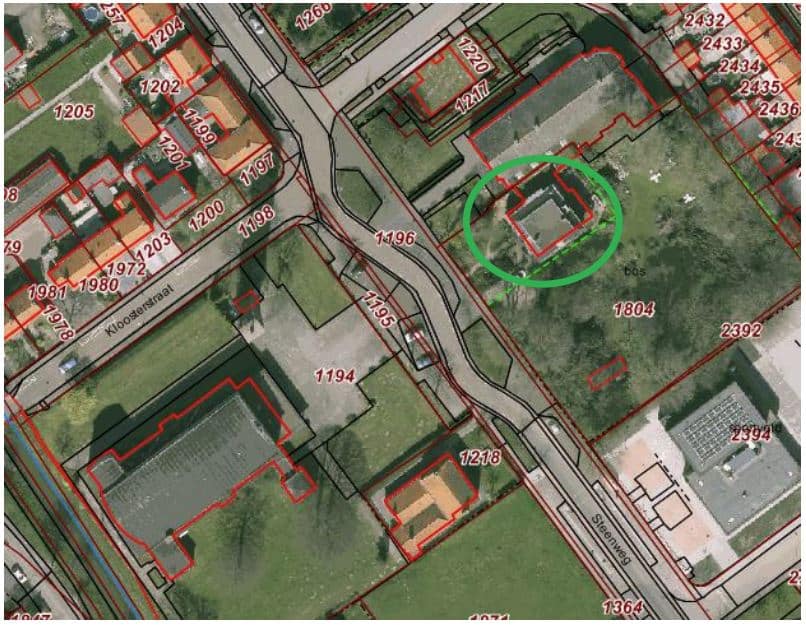
Located on the road to Breda, which was originally a through road.
Architectural and art-historical features:
Exterior
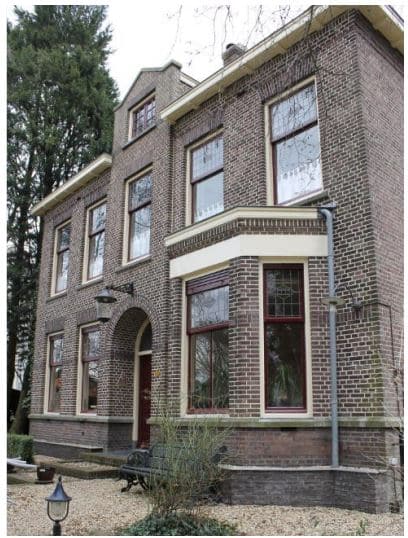
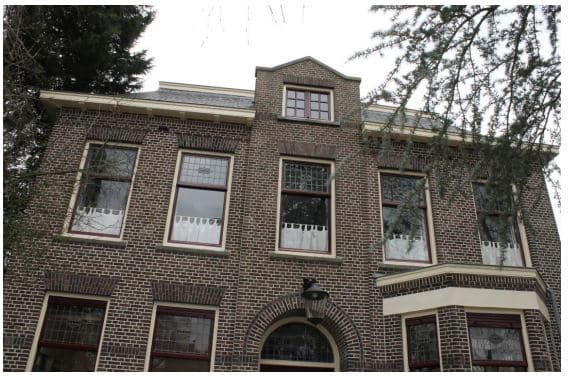
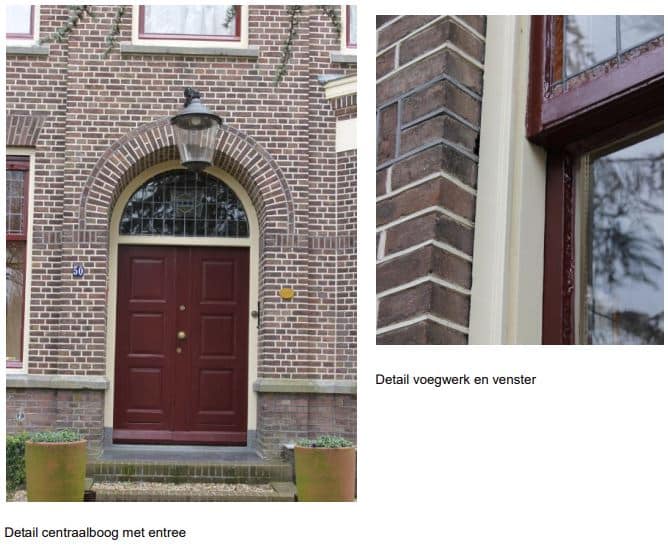
The parsonage was built in the traditionalist style. This style was widely used in the Netherlands between 1925 and 1965, but is unique within the municipality of Moerdijk. The facade is five bays wide, with the entrance set in a central round arch within the central projection. The central projection is topped by a small gable. The roof is a continuous hipped roof covered with dark slate. Adjacent to the left side wall is a single-story addition that originally connected the rectory to the church.
Public Interest
The property is of public interest. It has cultural-historical value because it is part of Moerdijk’s rich Roman Catholic history (late 18th–20th centuries). The building has architectural-historical value as a structure with facades built in the traditionalist style.
Condition of Maintenance
The overall condition of the parsonage is good.
Protection
The protection applies to the building at Steenweg 50 in Moerdijk. The main aspects of the elements worthy of preservation as historic monuments—which are related to the historic values of the entire property—are included in the explanatory description. For the property at Steenweg 50 in Moerdijk, this includes relevant elements of the exterior and (parts of) elevations visible from public spaces—in this case, the front elevations of the main building (the rectory) and the front elevation of the addition on the left side of the rectory, as well as the elements mentioned in the explanatory description.
Future changes or adjustments will be evaluated against this criterion. Friction. Future changes or adjustments will be evaluated against this criterion.

| Evaluation Criteria | Subcriteria | Parameter Descriptions | Score | Weighting | Points | Explanation |
|---|---|---|---|---|---|---|
| Silhouette effect | Silhouette Value | The object’s unique, defining significance to the character of its surroundings, neighborhood, city/town, or region | 1 | 2.0 | 2.0 | Distinctive; the silhouette is fairly clearly visible. |
| Subtotal | 0–6 | 2.0 | ||||
| Location | Ensemble Value | special significance of the property due to the high quality of the buildings in relation to the historical and spatial context | 1 | 0.5 | 0.5 | Located on the former main road to Breda. |
| the significance of the object as an essential (cultural-historical, functional, and/or architectural-historical and visual) component of a complex | 3 | 0.5 | 1.5 | Originally part of a complex (parish hall, church, and rectory), built in 1920–1930. | ||
| situational value | Distinctive location | 1 | 0.5 | 0.5 | In the center of the village, across from the postwar church. | |
| special significance of the property due to its layout, design, or amenities | 1 | 0.5 | 0.5 | Located on the former main road to Breda. Originally part of a complex (parish hall, church, and rectory), built in 1920–1930. | ||
| Subtotal | 0–6 | 3.0 | ||||
| Form | representativeness | the property’s special significance to the history of architecture and/or construction technology and/or the body of work of a master builder, architect, engineer, or artist | 3 | 1.0 | 3.0 | Designed by architect J.H.H. (Hubert) van Groenendael (1868–1942, a student of Pierre Cuypers, architect of, among others, the Rijksmuseum). Originally a parsonage, it was built in 1929 along with an adjacent church and parish hall (both destroyed by the ravages of World War II). |
| aesthetic value | significance of the property due to the design's high aesthetic qualities | 1 | 1.0 | 1.0 | The rectory, church, and parish hall were built in a traditionalist style. | |
| Use of Materials and Ornamentation | significance of the object due to its unique use of materials, ornamentation, and/or monumental art | 1 | 1.0 | 1.0 | A striking feature of the facade is the central projection that houses the entrance. | |
| integrity/recognizability | significance of the property due to its material, technical, structural, and/or architectural integrity and/or recognizability | 2 | 1.0 | 2.0 | The rectory is now the only remnant of the original complex and a reminder of Moerdijk’s rich Catholic history. | |
| rarity | significance of the building/complex due to its exceptional rarity from an architectural-historical, structural, typological, or functional perspective | 1 | 1.0 | 1.0 | It's fairly rare to find a parsonage in Moerdijk. | |
| Subtotal | 0–15 | 8.0 | ||||
| Cultural History | cultural and historical value | the significance of the property as a unique expression of cultural, socioeconomic, administrative/policy-related, spiritual, geographic, landscape, historical-spatial, technical, and/or typological development(s) | 3 | 2.0 | 6.0 | "Pastorie" refers to the rich Catholic history of the village of Moerdijk. |
| innovativeness | significance of the property due to its innovative value or pioneering nature | 0 | 1.0 | 0.0 | No innovative value. | |
| sentimental value | significance of the property due to its special sentimental value | 2 | 2.0 | 4.0 | The rectory serves as a reminder of the rich Catholic history and of World War II. | |
| Subtotal | 0–15 | 10.0 | ||||
| Position | authenticity | the significance of the property as a still clearly recognizable expression of its original or an important historical function | 1 | 2.0 | 2.0 | Quite recognizable. |
| Subtotal | 0–6 | 2.0 | ||||
| Total | 0–48 | 25.0 | ||||