
Replacement of Cables and Pipes in Willemstad Fortress
The cables and pipes in the Willemstad fortress are worn out and lack sufficient capacity for the future. That is why they are being replaced. On this page, you will find up-to-date information about the work.
The cables and pipes in the Willemstad fortress are in need of maintenance and replacement. This is necessary to keep the gas, electricity, water, and sewer systems in the fortress operational and safe. Work began in May 2025. The cable and pipeline operators are working together to ensure that the entire fortress is made future-proof underground in a single large-scale operation.
What's going on?
Just as in the rest of the Netherlands, work on cables and pipes is necessary within the Willemstad fortifications. Work will therefore be carried out throughout the fortifications, including the access roads Benedenkade and Landpoortstraat.
Due to the unique and historic nature of the fortification, the work requires thorough preparation and a meticulous approach. Enexis (gas and electricity), Brabant Water (drinking water), and the municipality of Moerdijk (sewer system) are joining forces for this project. The municipality is not the client but is participating as the sewer system operator and coordinating the work. Contractor Mourik is carrying out the work.
Nuisance
Disruptions are unavoidable. The work will be carried out in phases over a period of approximately 3 years. As a result, only a limited section of the fortress will be closed off at any given time. During the work, streets may be closed, and water, electricity, or gas may be unavailable for (short) periods. Residents and business owners will be notified of these changes well in advance.
There are many vulnerable buildings in Willemstad. In preparation for the construction work, a specialized firm will identify these buildings. This will take place shortly before work begins in a specific work zone, so that the current situation is clearly understood. During the construction work, the contractor will take measures to prevent damage to buildings.
Dikes
Part of the fortification is a primary flood barrier: a dike that protects against water from outside. From October 1 through April 1, no work is allowed on or around dikes—this is known as the closed season. Some of the cables and pipes are located in or near a dike. Work on them must therefore be done between April and the end of September.
Tourism and Hospitality
The summer season is important to Willemstad residents, business owners, and tourists. While it is impossible to completely prevent disturbances and inconveniences, the planning process takes tourists and outdoor dining areas into account as much as possible.
In phases
Work on the cables and pipelines is being carried out in phases, one work section at a time. In doing so, the construction team takes into account, as much as possible, issues that are important to residents, business owners, and visitors to the fortress, such as access to homes and businesses, events, tourism, the hospitality season, and, of course, water safety.
Customization
Whenever possible, the contractor offers customized solutions. Before work begins in a neighborhood, residents who wish to do so can discuss their personal circumstances—such as the accessibility of a home for someone using a wheelchair or a walker. Instructions on how to contact us regarding these types of situations are included in the letters you will receive about the construction work.
Would you like to share your ideas on how the construction team can carry out the work with as little disruption as possible for all of Willemstad? Sign up for the residents’ panel. Send an email to stan.knijff@moerdijk.nl. In your message, please include your name and phone number, whether you are a resident and/or business owner, and why you’d like to contribute your ideas. If there are many applications, the construction team will make a selection to ensure that the various interests are represented as well as possible on the panel.
Where is this location?
Current Status
The work will be thoroughly prepared. This will take place in 2024 and early 2025. Construction will begin in May 2025 and is expected to last approximately 3 years.
Planning
The cables and pipes are being replaced in phases. This means that only part of the fortress is being excavated at any given time. The city has been divided into work zones. Once one work zone is completed, the next one is tackled. This approach keeps disruption outside a work zone to a minimum.
By working in phases within specific work zones, we can take into account as much as possible the key considerations for Willemstad, such as flood control, as well as the tourist and outdoor dining season and local events.
The project is currently in Phase 3. In July 2025, work will be underway on Raadshuisstraat and the even-numbered side of Voorstraat. Paving work will continue here through the end of July. Work is also underway on Bovenkade. After the construction industry’s summer break (between July 21 and August 8), some additional work will be carried out there.
Phase 4 will then begin. This phase covers Rozemarijnstraat and (part of) the odd-numbered side of Voorstraat. In the subsequent phases, the contractor will take the Water Weekend into account. Furthermore, work on the dikes must be completed by October 1 for water safety reasons.
Contact
During the construction work, Lilian Nijzink, the construction team’s community relations manager, will be the primary point of contact for any questions or complaints. Lilian can be reached at:
- Tel. (085) 401 82 97
- Email: vestingwerk@mourik.com
- BouwApp: Willemstad Fortifications
Follow the project via the BouwApp. Download this (free) app to your phone. Or learn more on the BouwApp website.
Compensation for Losses
Are you suffering financial losses due to the construction work—for example, because you’re seeing a significant drop in the number of customers at your store or because you’re unable to rent out your property? If so, you may be entitled to compensation for losses. The conditions that apply are set forth in the Moerdijk Municipality Compensation for Losses Regulation.
Do you meet the eligibility requirements for compensation, or do you have questions about the program? If so, please send an email to info@moerdijk.nl. Please include “Legal Affairs/Compensation for Losses” in the subject line so that your message is quickly forwarded to the appropriate department. You’ll soon be able to apply for compensation for losses online as well.
Do you have a question about the project? You might find the answer below. If your question isn't listed here, please contact Community Relations Manager Heidi Galbraith at (085) 401 82 97 or vestingwerk@mourik.com.
Why is this work necessary?
The cables and pipes in the fortress are worn out. This makes them less safe and reliable. Furthermore, they lack the capacity needed for the future: for example, we use more electricity today than we did in the past. That is why replacement is necessary.
Who's on the job?
The various entities that manage cables and pipelines—Enexis (gas and electricity), Brabant Water (drinking water), and the municipality of Moerdijk (sewer system)—are collaborating in a construction team with contractor Mourik, which is carrying out the work.
Is the municipality of Moerdijk the client?
No. Cable and utility companies are required to keep their networks safe and reliable. Therefore, they may carry out work for that purpose at any time. In its coordinating role, the municipality of Moerdijk has arranged for the work to be consolidated to minimize disruption.
Will the construction work cause any inconvenience?
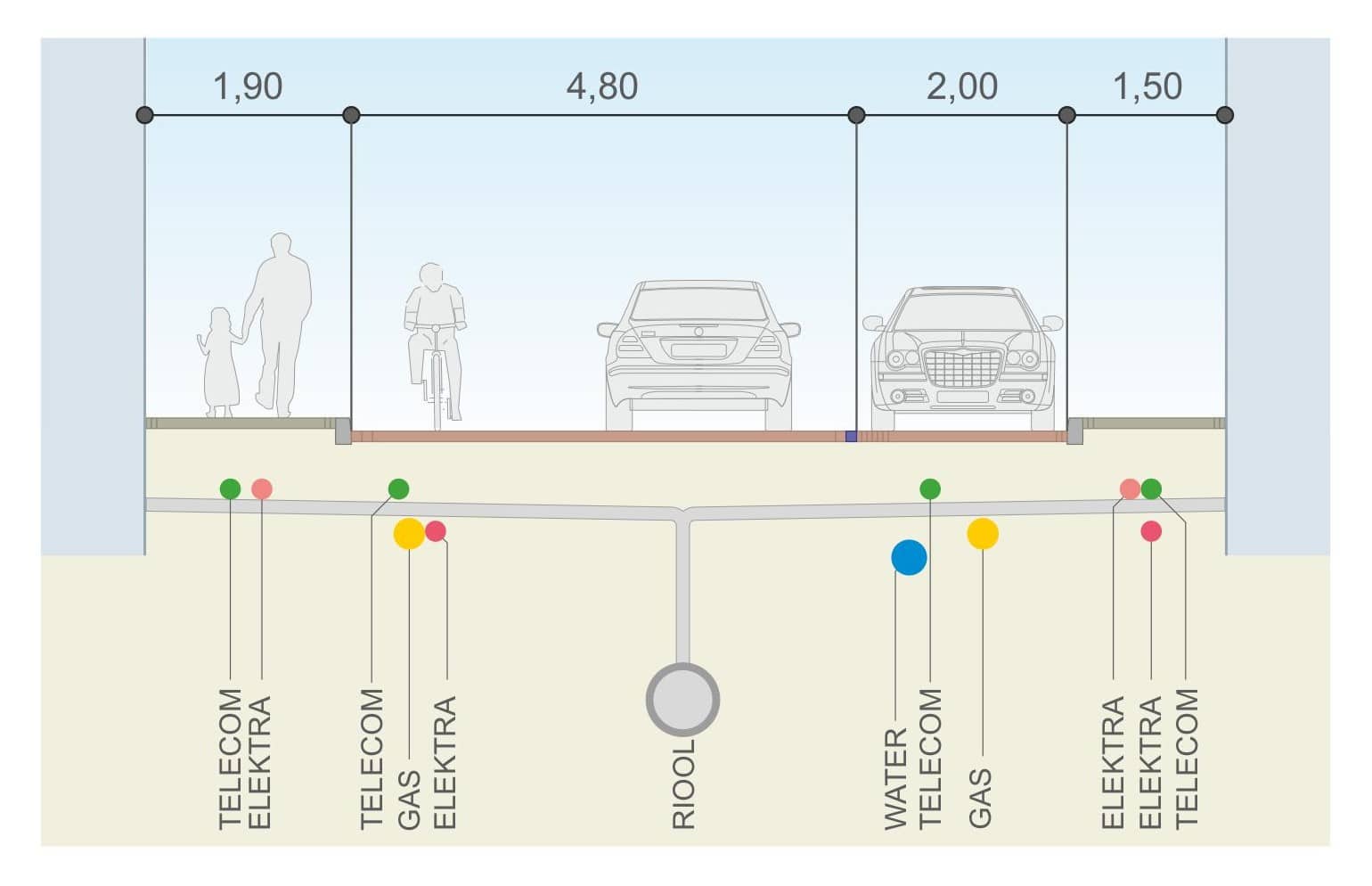
Yes. Streets are being torn up from one building to the next, and deep excavations are being made. So the street will temporarily become a construction site. This is necessary because the pipesrun acrossthe entire width of the sidewalks and the street and are at different depths.
Can streets be modified right away? For example, by adding more parking spaces, charging stations, or more green spaces?
No. While we understand the desire, unfortunately such a combination is not possible.
Street redesign requires a careful approach that involves resident input. That takes time. The work on the cables and pipes is essential and cannot wait. The work must be carried out as efficiently as possible, within the applicable constraints—such as the water board’s off-season—and with as little disruption as possible to the residents and business owners of Willemstad. This requires a tight schedule that leaves no room for additional work.
Will my home or business still be accessible?
There is a good chance that homes and stores will be temporarily less accessible while work is being done on the street. This could mean, for example, that a building is temporarily accessible only through a rear entrance or via walkways (planks laid across a dug-up street). During the planning phase, the situation will be assessed, and customized arrangements will be made where necessary—for example, for people with limited mobility or for stores that must remain accessible.
I'm planning to do some renovations myself—what happens if my street is being dug up?
If you are planning to renovate or carry out other work on or around your home or business, you should take these construction activities into account. From May 2025 through mid-2028, work on cables, pipes, and sewer lines will be carried out in phases. During this time, sections of the ramparts will be excavated, streets will be closed, and detour routes will be in place.
Please take these construction activities into account, for example, if you plan to place a dumpster in a public area. Inform suppliers and contractors about the restrictions so that they, too, can take appropriate measures.
What would happen if this work weren't done?
The older a network is, the greater the risk of malfunctions and incidents, such as a pipe break. When that happens, immediate action is necessary, even if it causes significant disruption to the surrounding area. That is why timely and scheduled maintenance is preferred: this allows disruption to be minimized as much as possible in consultation with the surrounding community.
Could this major repair have been avoided if more maintenance had been performed in recent years?
No. Cables and pipes don’t last forever: at some point, replacement and modernization become necessary. By thoroughly addressing the cables and pipes in a single operation, the duration of the disruption is minimized. After this work is completed, the fortress will once again be future-proof.
Who is the point of contact during the work?
The construction team’s environmental manager serves as the point of contact for all questions and complaints during the project. This means there is a single, shared point of contact for all parties involved in the work. More information on this can be found under “Contact.”
How can I stay informed?
There are several ways to stay informed. You’ll always receive a letter about important matters, such as the schedule for work on your street. You can always find the latest updates on this website:
. You can also follow the project on the BouwApp, which you can download for free (the app with the yellow hard hat). Then go to “Discover,” type “Vestingwerk Willemstad,” select the project, and click “Follow.”